
The Devil
Portuguese Folkloric Creatures

The Devil is universally considered the representation of evil, but different cultures and traditions attribute him distinct roles and degrees of evil. In Christian cultures when we talk about the Devil we are refering to Lucifer, and when we talk about demons we are refering to the other fallen angels. These are spirits who, having complete knowledge, denied God and, because of that, were deprived of His goodness, thus falling into complete evil. These are what we normally refer to as demons and their master, Lucifer, as the Devil.
But in Portugal the folkloric creature named “Devil” is a fusion of this Biblical Devil and of the ancient indigenous concept of devil. This syncretism happened because, even though the ancestors of the Portuguese were Christianised, they continued to hold some old beliefs and continued to practice ancient traditions. While some folk tales present the Devil in a very similar form to Lucifer, others represent him in a very distinct way, like a pagan god of the underworld, for instance. This pagan Devil is a very important figure in ancient festivals that the Portuguese people have uninterruptedly celebrated such as the festival of the Goat and the log (Festa da Cabra e do Canhoto), the Caretos, and others.
The Devil and his features
The Folkloric Devil is, as usual, a representation of evil. However this devil is not always absolute evil, but he is always an adversary of the forces of good. We can divide the tales about the Devil in four groups: the ones he is a deliverer of popular justice, the ones he is a merchant of souls, the ones he is funny, and the ones he resembles a pagan god or lord of the underworld.
Deliverer of Popular Justice
It may seem strange to attribute to the Devil the role of vigilante, but in many stories he represents popular justice, and I say popular justice, because his justice is not God’s justice, nor legal justice; but the justice that the masses desire when confronted with injustice. Because of that, his justice his brutal, unforgiving and partial.
Merchant of Souls
He is also a merchant of souls. The stories in which he plays this particular role are the ones he resembles Lucifer the most. There is an explicit desired to take the souls to hell making them commit the sins forbidden by Christianity. When he is present in these stories he is totally disagreable and becomes the evil creature of the Bible, distancing himself from the funny Devil and the deliverer of justice who are present in many Portuguese tales.
Funny Devil
In many folk tales the Devil plays the role of a powerful, but funny creature. In these tales the Devil’s part is intentionally funny, and sometimes he may even be deceived by humans, if they are smart enough.
Lord of the underworld
In these stories, the Devil becomes the lord of hell, like Lucifer, but unlike him, he has a wife and children. His wife may be a She Devil (Diaba), or may be a human forced to get married to this underworld creature. Also unlike Lucifer, this Devil is capable of love, like in one tale he reveals that he loves his son. It is in these type of stories that characters like the Horse of Thought (Cavalo do Pensamento) and White Flower (Branca Flor) appear. I will write an article about all this folkloric creatures and focus more about this type of Devil in another time.
Now I will give you examples of folk tales about the Devil, as a folkloric entity.
Devil as Merchant of Souls
Legend of the Lost Ring
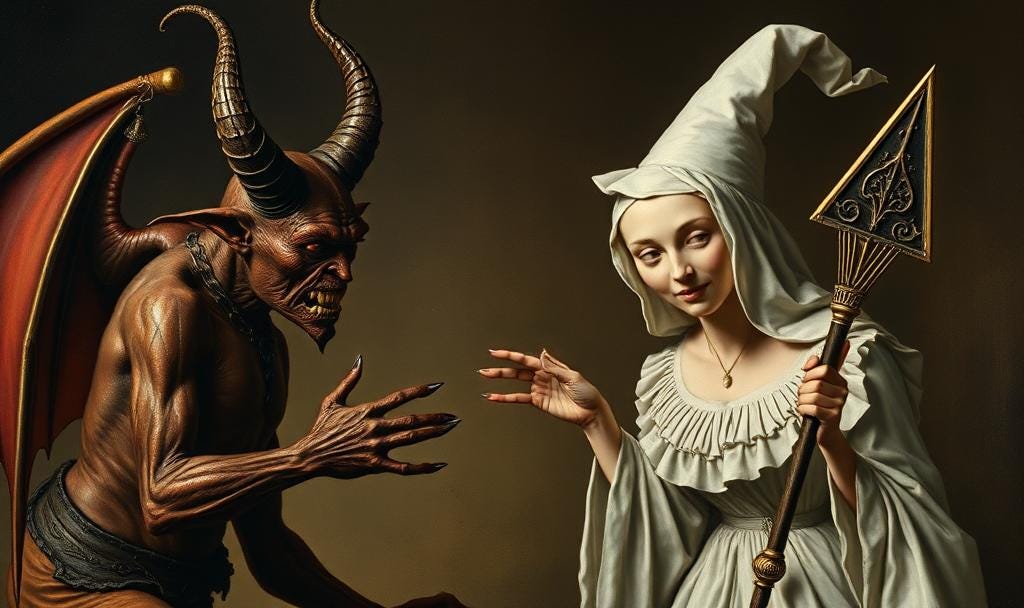
There was once a lady who had lost a ring, so her husband and his servant went to a witch to find out were the ring was. The witch told them to sleep at her house. At night the Devil came to the witch and told her that the Ring had fallen from the finger of the lady while she was feeding the pigs, and a blonde pig had eaten it, and now the ring was inside that animal. But the Devil ordered her not to say the truth: she should say instead that the lady had given the ring to a male friend, so that the husband, in anger, would kill his wife, and would thus loose his soul. Fortunatelly, the servant, who was unnable to sleep that night, was listening to everything. The witch told the husband what the Devil ordered her and, as it was expected, he became furious, and mounted his horse and went home at great speed, while the servant followed screaming for him to stop. He did not stop, and the servant had to say that if he did not stop, he would have to shoot him. He stopped and the servant was able to tell him the truth. When they arrived home they killed the pig, opened it and found the lost ring.
Devil as Deliverer of Popular Justice
Alms for the Devil
In a village of the Beira, there was a man with two boxes: one colected alms to God, the others colected alms to the Devil. The hikers would give a lot of alms, but only to God, so now and then the poor man would steal some coins from God and would give them to the Devil.
One day, the man decided to travel the country, so he started walking. When he arrived at an inn, he decided to ask the Inn Keeper for some eggs, because he was hungry. After having eaten the eggs, he asked for the bill, and when the inn keeper told him how much he had to play for a few simple eggs he was in shock! It was a fortune!
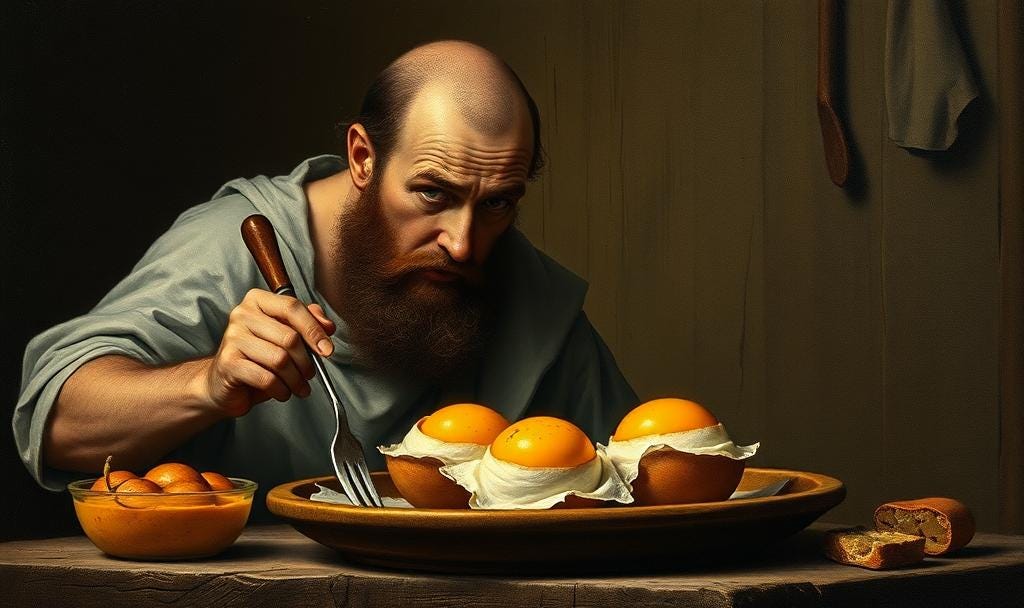
He asked the inn keeper why the eggs were so expensive. He answered that if he had not eaten the eggs, chickens would have been born from them and then they would have put more eggs for him. That was why they were so costly. The poor man accepted the explanation, but he did not have enough money to pay, so the inn Keeper arrested him until he could pay them.
A few days later a man with a big bag arrived there and asked for lunch. The inn keeper served him. The man with the bag started colecting all the peas and putting them inside his bag. Later the inn keeper gave him the Bill, but the man with the big bag told him that he would pay him only after the cooked peas had grown. The inn keeper was very surprised and said that cooked peas could not sprout, to which the man answered that neither could chickens be born out of cooked eggs. At this point, the inn keeper knew he was dealing with the devil, so he released the man who had given the alms to the Devil.
The Funny Devil
The Devil and the Farmer
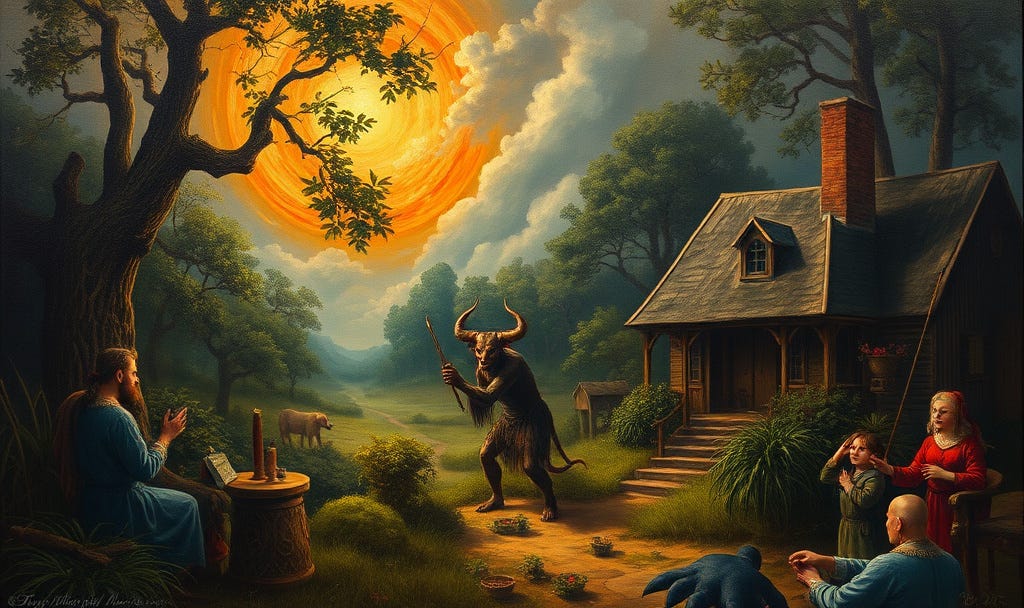
One day, the Devil decided to make a partnership with a farmer: the Farmer would work, while the Devil would pay for the seeds, fertilizers and other expenses. In the end they would share the crops. But the Devil did not want to share, and wanted to keep everything for himself, so he said to the farmer that everything that grew out of the soil would be his, and the Farmer could keep what was under the soil. So that year the Farmer planted only potatoes, carrots, beets and garlic. When the Devil arrived to collect his share, he was surprised that the Farmer’s share was so good, and his so bad; so he said that the next year he would keep only what was under the soil. The Farmer planted lettuces, bruccoli, peas and pumpkins, and again when the Devil arrived his part was not good for eating. From that point on the Devil did not want to make deals with that Farmer anymore.
Another attributes
Another role the Devil plays in Portugal is of builder. There are numerous bridges and ways that legend says were built by the Devil. Such is the case of the bridge of Misarela in Vila Real, also known as the bridge of the Devil (Ponte do Diabo), whose legend says was built in the middle ages, when a criminal was running away from authorities, and being unnable to cross the river asked the Devil for assistance, so the Devil made him a bridge. The type of devil who builds things is called Galhardo (Singular) or Galhardos (plural), so many bridges are called “bridge of the Galhardos” or some ways “the way of the galhardos”, because legend says they were the ones who built them.
The role the Devil plays in the Celtic Traditions of Northern Portugal
The Devil is also important as a representation of evil in the Celtic traditions of Portugal. Villages of Trás-os-Montes have celebrated Celtic festivals and have mantained Celtic traditions for thousands of years, and the end of October is especially important because it is the start of what they called “the dark season”, which is the winter. This area of Portugal is located in the north and is montainous, so the winter is very cold, windy and with a lot of rain. That is why the Celts, who were the ancestors of the people of Trás-os-Montes, would perform rituals to garantee the safety of the population throughout the season. One of these festivals is the festival of the Goat and the Log in the village of Cidões. Around the 31st of October, those whose ancestors are from Cidões, return to the village to prepare the festival whose main characters are the goddesses, the druid and the devil1: while the goddesses and the druid represent the forces of good, the Devil represents evil. The main dish is the Goat Machorra (an infertile goat) and represents the Devil’s wife, who will be eaten by the population. The party is animated by traditional Celtic music and the village is decorated with Celtic motives.
(Note that the druid is not in fact a druid, but a normal man disguised as a druid, because all the population is Catholic; the male goat that will be offered in sacrifice and burnt in the fire is a giant doll, not a real goat; and the goat machorra is indeed a real goat, but is the meal, and is not killed in public)
Later, the druid and the goddesses will make a conjuration so that all evils depart from the village and leave the population, and ask for fertility and prosperity for the dark season (winter)2. At eleven oclock at night, it’s the time a goat is thrown into the fire by the goddesses, because the goat is the animal that represents the Devil. At midnight the Devil arrives very angry, because the population ate his wife and burnt the goat. It is at this point that the druid fights with the Devil and after obtaining victory, he garantees another year of safety and prosperity for the village.

Even though the folkloric Devil is a result of syncretism and does not always represent absolute evil, in the end he is still considered an evil creature, who is not only dangerous but can also being misfortune to the entire community.
https://www.mdb.pt/noticia/festa-da-cabra-e-do-canhoto-celebra-tradicao-milenar-em-cidoes
https://www.mdb.pt/noticia/festa-da-cabra-e-do-canhoto-celebra-tradicao-milenar-em-cidoes